THE ONYCHOPHORAN PROTOCEREBRUM WAS ANCESTRALLY BIPARTITE: Developmental evidence from a phosphatised early Cambrian lobopodian
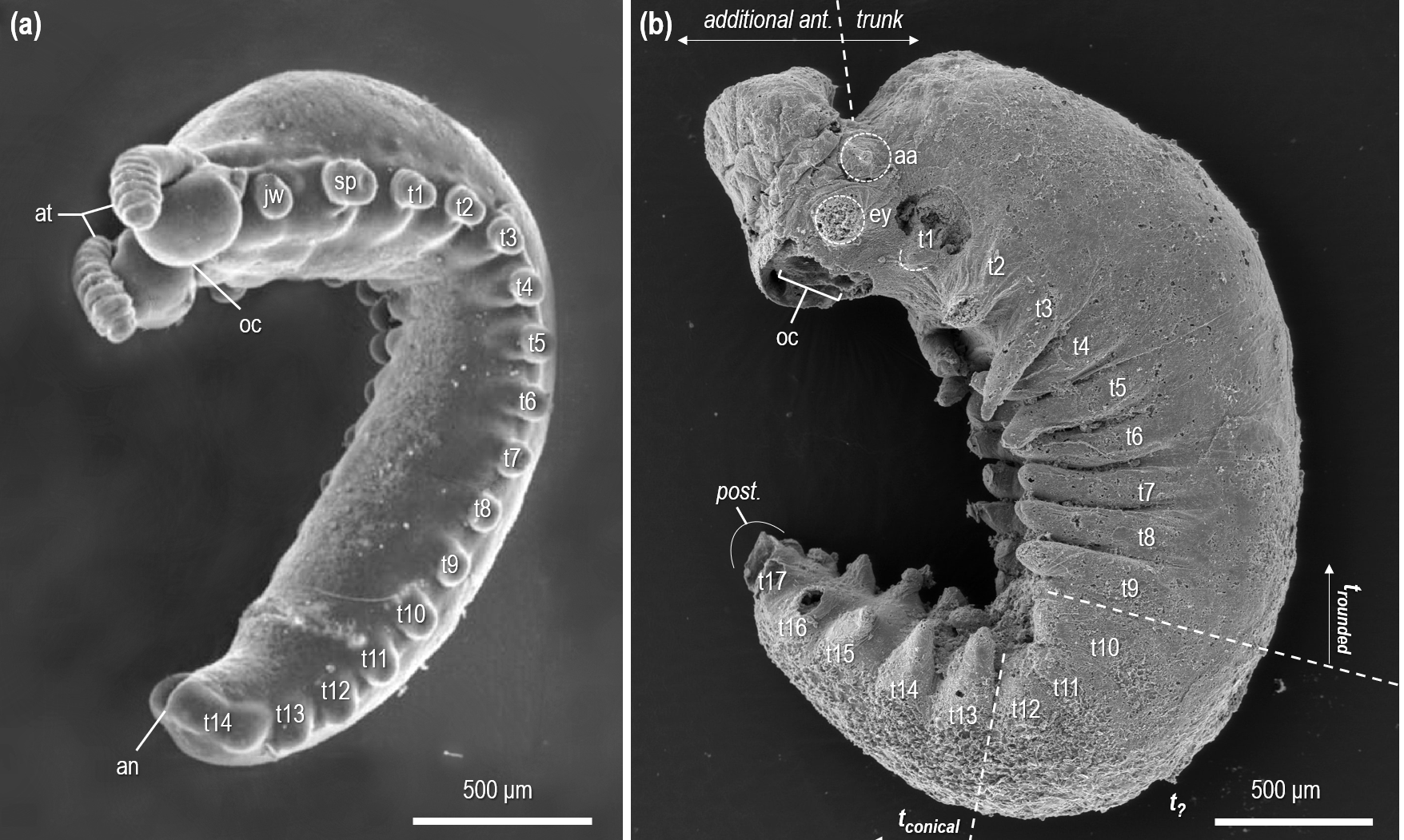
The panarthropods (euarthropods, tardigrades, and onychophorans) are the most diverse and successful group of animals on the planet. The ‘heads’ of these animals are evolutionarily and morphologically plastic regions comprising modified appendage-bearing segments. Despite decades of genetic, embryological, and palaeontological research, the segmental homologies of these appendages remain disputed. Illuminating the evolutionary origins of the first protocerebral segment may hold the key to understanding the panarthropod head. The protocerebral segments of extant onychophorans and euarthropods are genetically subdivided into an apical antennal / labral domain and an ocular domain by expression of the genes optix and orthodenticle (otd). Unlike the segmental otd element, the antennal optix region lacks the engrailed (en) segment boundary indicator gene and is thus considered asegmental. The presence of two protocerebral genetic domains suggests that this region was ancestrally bipartite, composed of morphologically discrete asegmental and segmental components. Until now, the hypothetical ancestral division of these domains has been based principally on modern developmental studies, supplemented with macrofossils of adult euarthropods and onychophorans. Here I provide the first palaeodevelopmental data, from a phosphatised Cambrian (stage 3) stem-group onychophoran embryo from China’s Yu’anshan Formation. This specimen provides the first fossil evidence for an ancestrally bipartite protocerebrum. The protocerebrum is made up of an apical asegmental domain containing a dorsal brain, which innervates antenniform frontal appendages, and a subsequent ocular domain in the first true body segment, homologous with the ocular otd element. The onychophoran antennae are thus asegmental, and not homologous with segmental appendages. The configuration of the specimen’s eyes provides morphological support for their appendicular origins, suggesting that eyes, rather than antennae, are the protocerebral appendages of onychophorans. The pre-oral raptorial-like appendages and labral complexes of euarthropods are therefore asegmental, and homologous to the onychophoran antennae. The loss of the ancestral nerve ring, the incorporation of the second trunk appendage into the head, and the fusion of the asegmental and segmental protocerebral domains into a single element occurred independently in Euarthropoda and Onychophora – weakening the case that these phyla form a clade, consistent with fossil, musculoskeletal, and neurological evidence that tardigrades are the sister-group to the euarthropods (the Tactopoda hypothesis).
-
picture_as_pdf - ELong_MScR_Thesis_2019.pdf
-
subject - Accepted Version
-
subject - Thesis
-
image - Plate_1.png
-
subject - Supplemental Material
-
subject - Plate 1

-
image - Plate_2.png
-
subject - Plate 2

-
image - Plate_3.png
-
subject - Plate 3